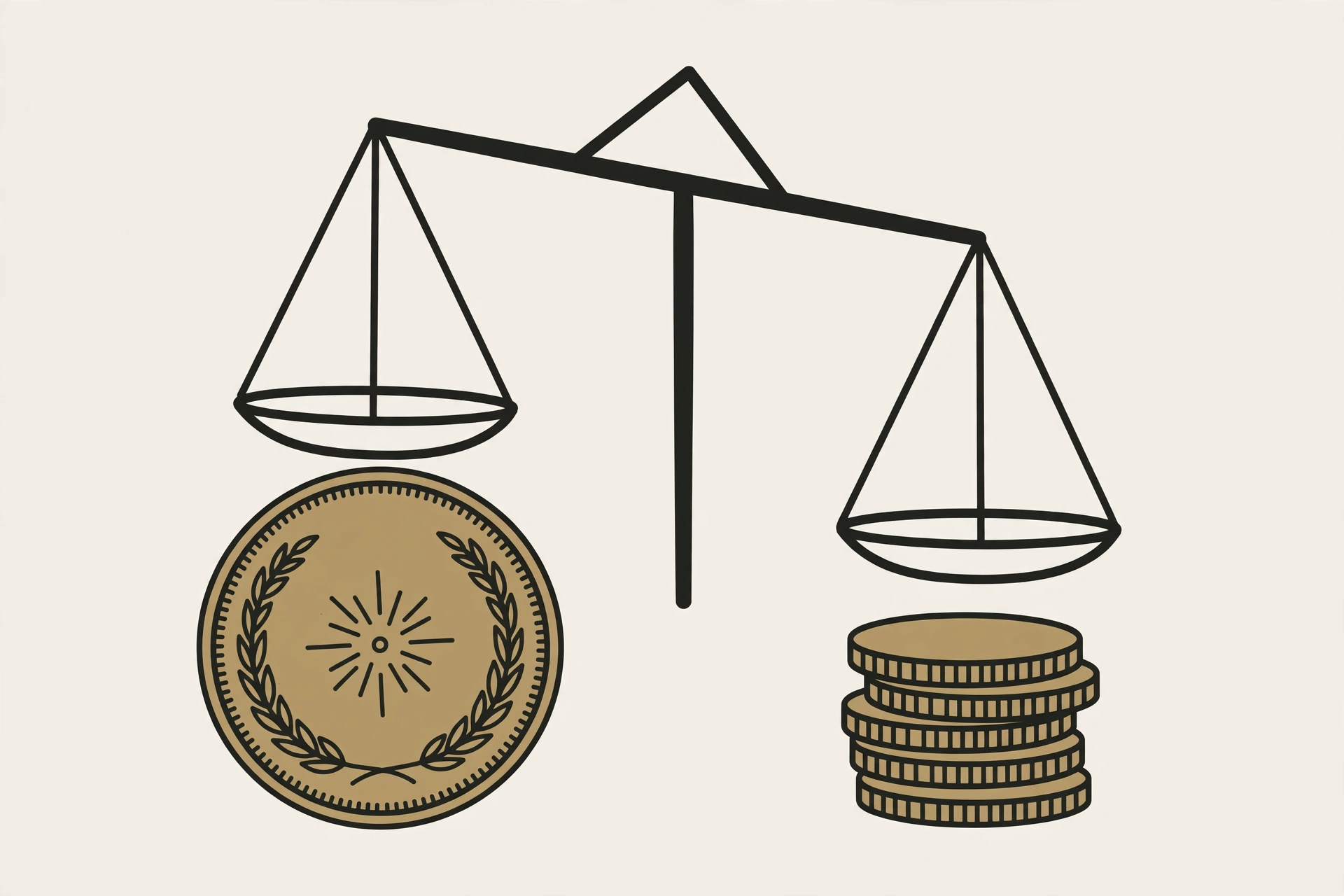
What “value” actually means
To value a stock is to answer one question: what is a claim on this business's future cash worth today? Everything in valuation is a version of that question. The share price is the market's current collective answer. Your job, if you choose to do valuation at all, is to form your own answer and compare — knowing the market's answer is usually smarter than yours.
Earnings: the starting point
The foundation is earnings — the profit left after all costs, divided by the share count, giving earnings per share. A company earning $5 per share generates $5 of profit attributable to each share every year. Earnings are backward-looking (they describe what happened) and imperfect (accounting choices shape them), but they are the closest thing to a factual anchor valuation has.
The multiple: price set against earnings
Divide the share price by earnings per share and you get the P/E multiple: how many dollars the market pays for each dollar of annual earnings. A $100 share on $5 of earnings is a multiple of 20 — twenty years of today's earnings to match the price. The multiple is a comparison, not a grade. It tells you how the market is pricing this earnings stream relative to others.
Why multiples differ
Multiples differ because expectations differ. A business expected to grow earnings rapidly commands a higher multiple — holders are paying for the future, not the present. A business with shrinking earnings gets a lower one. Risk matters too: uncertain earnings get discounted more heavily. None of this is a judgment; it is arithmetic applied to beliefs. Two reasonable people can look at the same multiple and see different things, because they hold different beliefs about the future.
A price is never a verdict
Here is the discipline: a high multiple does not mean overpriced, and a low multiple does not mean underpriced. Some of history's best investments carried high multiples for years while earnings grew into them. Some of the lowest-multiple stocks stayed at low multiples because the earnings kept shrinking. The multiple describes how the market is pricing the business. Whether that pricing proves right is a question about the future, and the future does not file preview statements.
What multiples cannot tell you
Multiples are blind to quality of earnings (one-time gains flatter them), to debt (two companies with the same P/E can carry very different obligations), and to change (today's earnings say little about a business being disrupted). Valuation is a starting point for thinking, not a conclusion. Anyone presenting a multiple as a verdict is selling certainty the number does not contain.
Worked example: Same earnings, different prices
Illustrative figures only, to show what a multiple compares.
| Share price | Earnings per share | P/E multiple | |
|---|---|---|---|
| Company A | $100 | $5 | 20 |
| Company B | $40 | $5 | 8 |
Identical $5 earnings. The market pays $100 for A's earnings stream and $40 for B's — because it expects different futures. The multiple records the difference in expectations; it does not say which expectation is right.