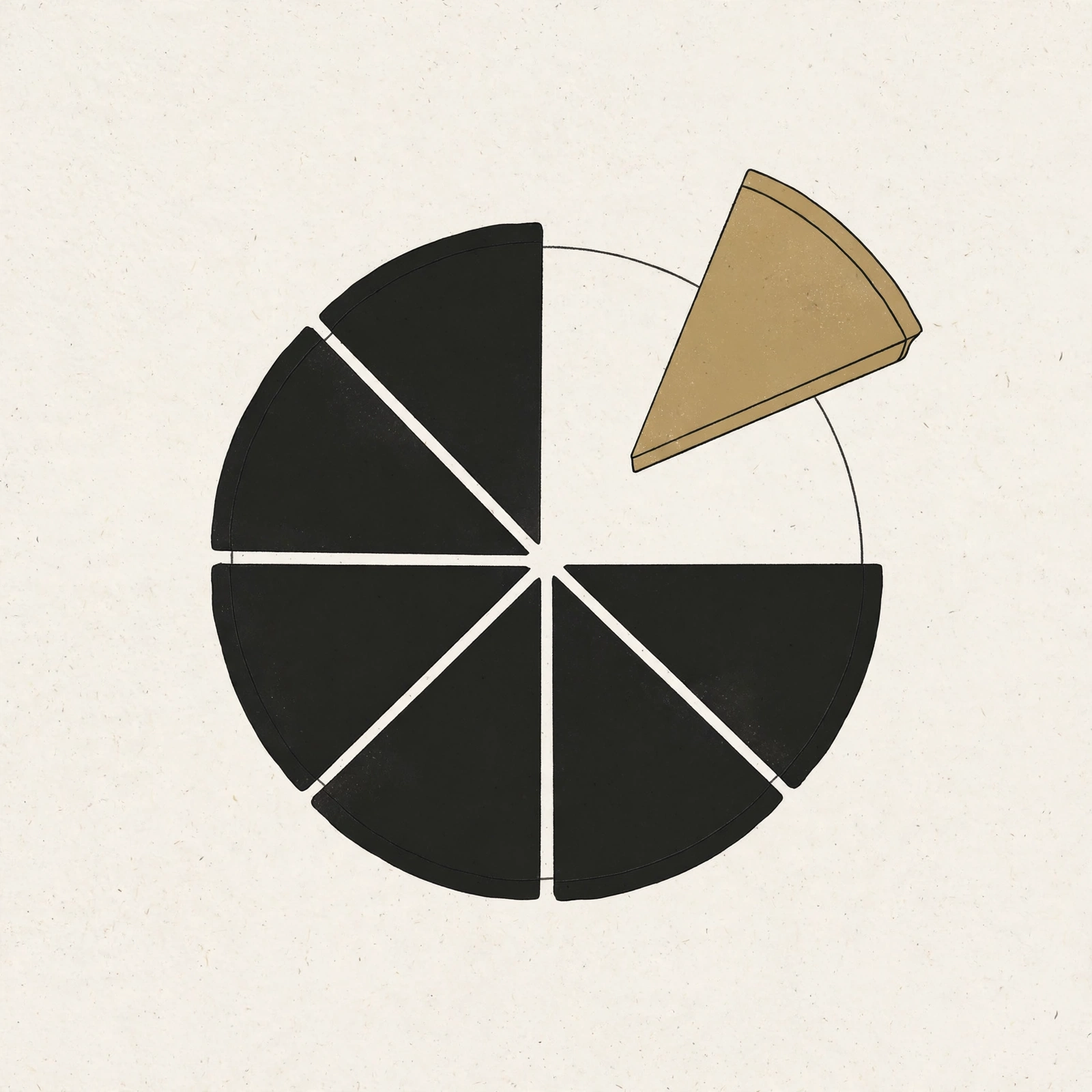
A slice of a business
When a company “goes public,” it divides itself into pieces and offers those pieces to anyone. Each piece is a share. Owning a share means owning a tiny fraction of the company itself — its factories, its cash, its debts, its future profits, all of it, in miniature. You are not renting a ticker symbol. You are a part-owner, at whatever scale your slice represents.
Why a slice has value
A share has value for one reason: the business underneath it is expected to generate cash over time. People pay for a share today based on what they believe that slice of the business will become worth. That belief changes constantly — with earnings, with the economy, with mood — which is why the price moves even on days the business itself did nothing new.
Shares outstanding: why the count matters
A company's total value is its share price multiplied by the number of shares in existence, called shares outstanding. A $50 share of a company with two billion shares outstanding represents a far larger business than a $400 share of a company with fifty million shares outstanding. The share price alone tells you nothing about size — it is one half of a multiplication.
What you actually get
As a shareholder you typically get two things: a vote on major company decisions, and a claim on a portion of profits if the company chooses to distribute them, which is called a dividend. Many growing companies pay no dividend at all and reinvest everything instead. In that case your return comes only from the share price changing — which means it depends entirely on what future holders will pay.
What a stock is not
A stock is not a lottery ticket and not a loan. A lottery ticket has no underlying value; a share always represents a claim on something real, even when the price disagrees with you. And unlike a loan, there is no promise to pay you back — no interest, no maturity date, no guarantee. The company owes you nothing except your proportional rights as an owner. That asymmetry is the whole deal: unlimited participation in the upside, and the possibility of losing what you put in, with nothing in between promised.
The price is a vote, renewed every second
Here is the part beginners miss: the share price is not a measurement, like a thermometer reading. It is the current consensus of thousands of strangers negotiating with each other. The business changes slowly, quarter by quarter. The consensus can change in seconds. Keeping those two ideas separate — the business and the vote about the business — is the foundation of everything that follows.
Dilution: your slice can shrink
Companies can create new shares — to raise money, to pay employees, or to fund an acquisition. When they do, every existing slice gets thinner: you own the same number of shares, but each one represents a smaller fraction of the company. This is called dilution. It is not automatically bad — if the new shares fund growth worth more than the dilution costs, everyone can still come out ahead — but it means your ownership percentage is not fixed. The share count moves over time, which is one more reason the share price alone never tells the whole story.
Worked example: One price, two very different companies
Illustrative figures only, to show the arithmetic.
| Share price | Shares outstanding | Total value | |
|---|---|---|---|
| Company A | $50 | 2,000,000,000 | $100,000,000,000 |
| Company B | $400 | 50,000,000 | $20,000,000,000 |
The $400 share belongs to the smaller company. Price alone said nothing.