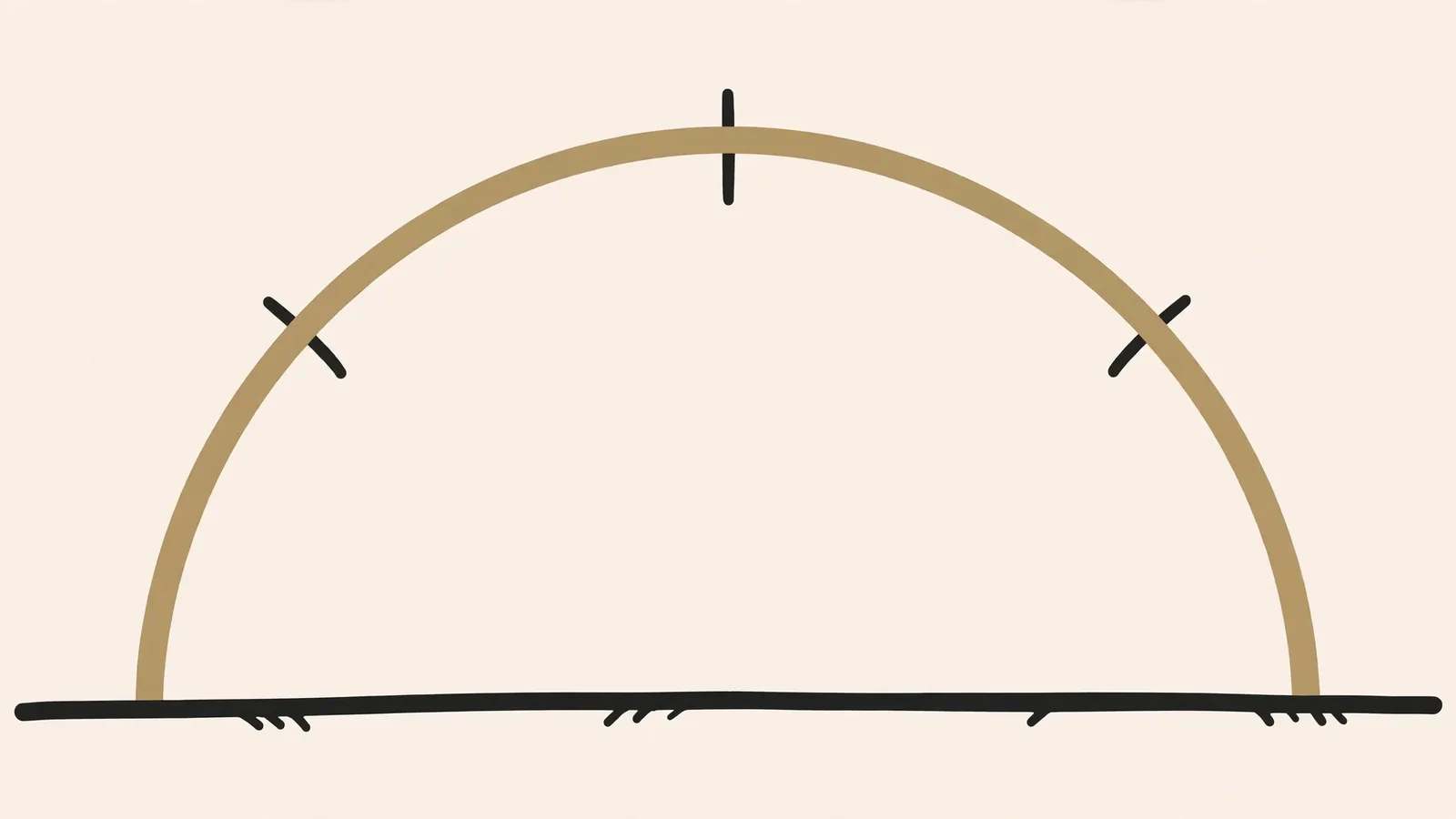
The day’s four markets
Premarket (from 4 a.m. ET, thin until the bell): few participants, wide spreads (Lesson 2’s bid and ask, stretched), prices that gap on headlines and frequently mean little by 10 a.m. The open (9:30, and the auction that sets it): the day’s first real price discovery, heavy volume, overnight news being priced all at once — the most honest and most violent minutes of the day. Midday: volume ebbs, ranges compress, the day’s character declares itself. The close (the final half hour, and the closing auction): index funds and institutions execute their day’s business in size, volume surges again, and the prices that editions grade are struck. Liquidity through the day usually traces a U: deep at both ends, shallow in the middle. Together, premarket and the after-hours session that follows the close (running to 8 p.m. ET) make up the extended hours: thinner books and wider spreads than the regular session’s, prices set by fewer hands — which is why this desk reads in them and rests its orders for the deep rooms.
None of this is trivia. Every price you have ever seen printed was made in one of those four rooms, and the rooms have different rules of evidence. A level tested at the deep, auctioned close is Folder 3’s fact. A level ‘tested’ at 7 a.m. on forty shares is a rumor with a timestamp. And read the whole map as a tendency, not a law: a rate decision at 2 p.m. can make midday the deepest hour of the day, and a quiet holiday-week close can run thinner than a normal noon. The U is the day’s usual shape — the exceptions are the days the news rewrites the schedule.
Execution is a cost, not a detail
Between the price you see and the price you get stands the spread, and in thin rooms the spread is a tax with a meter. The worked example below prices it: the same order, at three hours of the day, pays three different costs for the same shares — and the differences, compounded over a year of trades (Lesson 21 again), are a real line in the account’s P&L that never appears on any statement labelled as such.
Order type is the working trader’s answer. A market order says ‘now, at whatever the room charges’ — acceptable in deep rooms at liquid hours, reckless in thin ones. A limit order says ‘this price or better’ — a resting (nonmarketable) one can miss a trade entirely, and in exchange it can never be fleeced by a wide spread; a marketable one, priced through the quote as the worked example shows, executes at once — it pays the crossing toll, but never worse than its limit. For a reader who places orders before work and cannot watch the fill, the limit order’s bargain — certainty of price, uncertainty of execution — is usually the honest one. The missed trade pays no toll (its real cost is the opportunity, priced honestly in the example below). The fleeced fill costs every time.
Fills also arrive in pieces. An order for 200 shares in a thin room may fill 60 now, 40 the next time the price trades at your level, and the rest never — a partial fill, leaving a position smaller than the plan sized, with the remainder still working. Marketable orders in fast rooms partial-fill the same way. Decide the answer in advance, in the calm room: let the remainder keep working, or cancel it — not improvised at the fill alert.
The working person’s session
This track’s reader executes around a job, and the day’s map, properly read, is kind to that constraint. The pre-market read (Lesson 24) happens in the thin room but only reads there. Orders, when the plan calls for them, are written as limits at the plan’s prices and left to the deep rooms to fill or refuse. The close — the day’s other honest price — is not attended either. The Final Hour publishes in the session’s final hour, before the close; its checks are as of its timestamp and provisional. What settles on the close is settled in print the next morning, when the morning edition publishes the official answer. The sessions a working trader actually needs are the ones their orders are resting in, not the ones on a screen.
What this posture refuses is the midday improvisation: the lunchtime market order into a shallow book, the stop nudged from a phone, the plan edited by a push alert. Those are executions performed in the worst room at the worst hour by the least calm version of the trader. Lesson 24’s rhythm and this lesson’s map are the same teaching from two sides: be present in the deep rooms by preparation, and absent from the shallow ones by design.
The close is the grade
End where the journal ends: the closing auction is the session’s verdict because it is its deepest, most contested price — the one the levels are finally graded against, in print the next morning, the one mutual funds are priced at, the one history records. A reader who understands the day’s four rooms understands why Folder 3’s rule is a close through the shelf and not a wick at noon: the close is where the whole market showed up to vote. Intraday prices are arguments. The close is the count.
Execution, then, in one sentence for the plan page: decide in the calm room, rest orders at your prices, let the deep rooms work, and grade everything at the close. The sessions will take care of themselves; they have a shape, and now you have its map.
Worked example: the same order, three rooms
A hypothetical order: buying 62 shares of a mid-cap name, quoted three ways in one day. One convention throughout: the cost of immediacy is the ask-to-midpoint distance, times the shares:
| Hour | The quote (bid / ask) | Cost of crossing the spread | The room |
|---|---|---|---|
| 7:40 a.m. | $49.60 / $50.40 | 62 × $0.40 = $24.80, and thin size | Premarket — a rumor’s price |
| 10:05 a.m. | $49.97 / $50.03 | 62 × $0.03 = $1.86 | The open’s depth, still working |
| 3:55 p.m. | $50.10 / $50.14 | 62 × $0.02 = $1.24 | The close’s auction building |
Same shares, same day: a twenty-fold difference in the toll for immediacy. A limit order resting at your price is passive: it pays none of the three tolls, and standing in line can even earn a fill better than the quote suggested. But price control is not cost control. The passive order’s costs are real — the fills it misses (often the very moves it was placed for) and the fills it receives precisely when the room knows something it doesn’t. They never appear on a statement, which is not the same as not existing. Price the same order through the quote instead — a marketable limit — and it behaves like a market order with a ceiling: it pays the crossing toll, capped at your price.
Where this breaks
The day’s shapes are tendencies with named exceptions, not a timetable — a 2 p.m. rate decision can make the sleepy midday the deepest room of the day, and a holiday-week close can run thin. A plan can also be half-executed: partial fills leave the remainder unfilled at your price, so the decision to work the rest or cancel has to be made before the order exists, not improvised from a desk.
Practice
Paper scenario. A fictional stock shows a bid of $29.90 and an ask of $30.30 at 8:15 a.m., and a bid of $30.48 and an ask of $30.52 at 10:30 a.m. Using this lesson’s convention — the cost of immediacy is the ask-to-midpoint distance, times the shares — price a hypothetical 50-share market order at each time. (1) The toll at 8:15. (2) The toll at 10:30. (3) A resting limit order at $30.00 in the morning fills 20 of 50 shares before the price runs away: what has happened, in the lesson’s term, and what decision did the plan owe in advance?
Answers: (1) Midpoint $30.10, distance $0.20, toll $10.00. (2) Midpoint $30.50, distance $0.02, toll $1.00 — the same stock, the same order, a tenth of the toll, for arriving in the deep room. (3) A partial fill: the plan owed a decision on the unfilled 30 shares — keep working the order at the limit, or cancel and let the trade go — made before the session, not during it.
Sources
Sources: market hours, holidays and early closes are published by the exchanges themselves — the New York Stock Exchange’s hours and calendars page and Nasdaq’s market schedule, which states the regular session (9:30 a.m.–4:00 p.m. ET) and the extended sessions around it. Checked October 2026. Your broker’s extended-hours window may be narrower than the exchange’s — the broker’s stated hours govern your orders.
Terms in this lesson: Bid · Ask · Spread · Limit order
From readers
Questions, answered
No questions answered here yet — yours could be the first.
Audio edition: this lesson, read aloud from the text on this page.