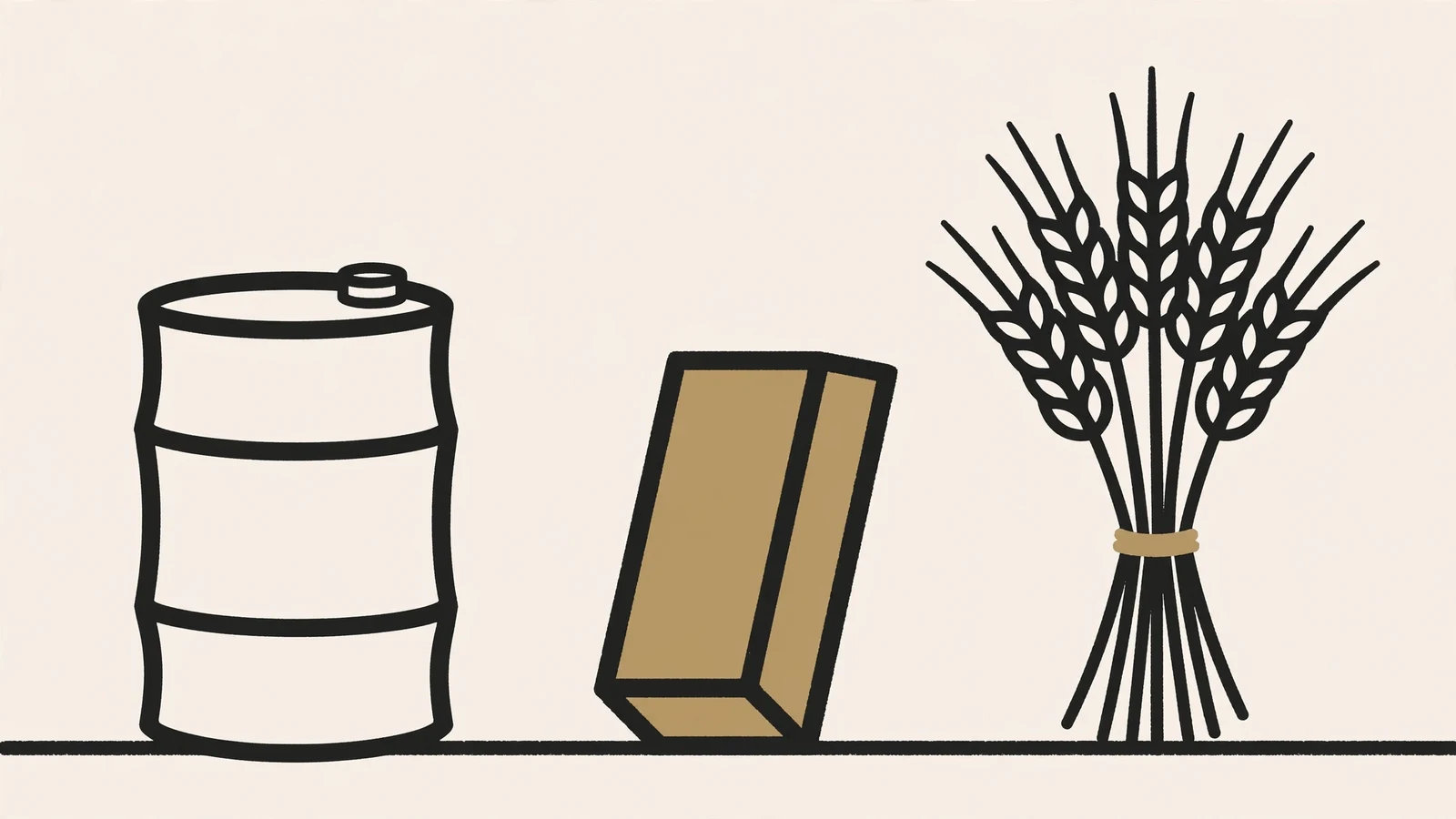
Priced by the physical world
A company's stock is priced on expectations about a business. A commodity is priced on facts about a thing — and on expectations about those facts, which arrive earlier. Oil is priced on how much of it exists, how fast it is being used, and how much room there is to store it. Wheat is priced on a harvest that has not happened yet, in weather that has not finished happening. A drought is not a metaphor in this market; it is a supply event with a price attached. And expectations move prices before any physical fact lands: when a major producer announces a future production cut, the price rises that day — not one barrel has been produced or stored differently yet, but the supply the market now expects has changed. Announcements matter here precisely when they change what people expect about barrels produced, bushels expected, ounces stored. It matters beyond the trading screen, too: these are the prices behind fuel, food, and the commodity lines on the journal’s tape every morning.
Standardized, so they can trade
A market needs the thing traded to be the same thing every time. So commodities are defined by grades and units: a barrel of oil of a stated quality, a bushel of wheat of a stated grade, a troy ounce of gold of a stated purity. That sameness is easy to overlook and it is the whole trick — it turns goods scattered across farms, mines, and ports into one price the whole world can trade. Without the standard, every sale would be an inspection. With it, a farmer and a fund can meet in the same market.
Keeping the good costs money
Goods take up room, and room costs money. Oil needs tanks, grain needs silos, everything physical needs insurance against fire, spoilage, and time. That cost of keeping — storage, insurance, financing — lives inside the price. It is why the price of oil for delivery six months from now usually differs from today's price for the same barrel: the later price has the keeping in it. Harvests make the point sharpest. A crop arrives when it arrives; it cannot wait for a better price, so supply lands on the market on nature's schedule, not the market's.
Almost nobody takes the oil
Here is the quiet fact underneath this whole market: almost nobody in it wants the good itself. The airline hedging fuel, the fund holding a view, the trader watching storage numbers — none of them has a tank. So commodities are reached through the vehicle from Lesson 14: futures contracts, settled in cash or closed before delivery. This lesson owns the goods; that one owns the contract. When you read an oil price, you are reading a contract's price for a good that will almost certainly never change hands between the people trading it.
Four ways to reach a good
Futures are the professional's road in, but they are not the only one, and the four roads are not interchangeable. Holding the physical good — gold coins or bars of your own — is the direct version: no expiry, no contract, and the price you follow is the good's own. Its costs are the keeping: storage, insurance, and a dealer's spread when you sell. For oil or grain it is impractical for almost everyone; nobody's garage is a tank farm. Futures are Lesson 14's road: the good's price exposure on a small deposit, settled daily, with an expiry to roll — the purest exposure, and the most demanding of your attention. Commodity funds — pooled funds bought and sold like a share — hold futures or, for some metals funds, the metal itself, and spare you the contract work; in exchange you pay the fund's fees, and because futures-based funds must keep rolling their contracts, their returns can drift away from the good's own price over time. Producer equities — shares in the miners and the oil companies — are ownership of a business, not of the good: the commodity's price drives their earnings, but so do their costs, their debts, and their management, so a producer's shares can fall in a year the good itself rose. Same good, four instruments: what you own, what it costs to keep, and what can surprise you are different in each.
A different calendar
Earnings season does not run this market. Commodities keep their own calendar: weekly petroleum inventory reports that count the barrels in storage, monthly crop reports that revise the harvest, OPEC meetings where producers argue about supply in public. Learn which headlines belong here and a confusing market gets quieter: a surprise draw in inventories is real news; a celebrity CEO's opinion of oil is not. The journal's tape reads this calendar daily — production, storage, weather — because in this market those are not background. They are the fundamentals, arriving on schedule.
Gold, the odd one out
Gold deserves one honest note, because it breaks the pattern this lesson just taught. It is barely consumed — nearly all the gold ever mined still exists — so its price is not set by harvests or storage draws the way oil and wheat are. It is held, by central banks and savers alike, as a store of value, and it moves on that demand: fear, interest rates, and the appetite for something that is nobody's promise. Same market, same contracts — a different set of facts. Knowing which facts drive which good is the lesson.
Worked example: Follow one barrel
An illustrative week, traced the way this desk reads it.
| Step | The physical fact | What it did to the price |
|---|---|---|
| 1 | A major producer announces a production cut | The price ticks up — less future supply |
| 2 | The weekly inventory report shows a bigger draw than expected | Up again — less oil in storage than the market assumed |
| 3 | The journal's next morning tape prints oil | The line in the macro block reads exactly those two facts |
No earnings, no guidance, no CEO. Barrels promised and barrels counted moved the price — the physical world, priced. That is the whole lesson in one barrel.
Practice
Read this fictional morning and label each piece. A weekly report counts 2 million fewer barrels in storage than expected. The same morning, a major producer announces a production cut that starts next quarter. The oil price rises $3 that day. (1) Which piece is a physical fact, and which is an expectation? (2) Why could the price move today, before the announced cut removes a single barrel? (3) Name the three costs of keeping a physical barrel that live inside its price.
Work it through: (1) The storage count is a physical fact; the announced future cut is an expectation. (2) Prices rest on expectations of facts as well as facts — the market repriced future supply the moment the announcement changed what it expects. (3) Storage, insurance, and financing — the cost of keeping the good.
Terms in this lesson: Commodity · Futures contract · Delivery
From readers
Questions, answered
No questions answered here yet — yours could be the first.
Audio edition: this lesson, read aloud from the text on this page.